Bureau of Indian Standards Certificate
The Bureau of Indian Standards (BIS) Certificate stands as one of the most trusted indicators of quality, safety, and conformity for products sold within India. Whether manufactured locally or imported, many products must meet defined Indian Standards before they can be legally sold in the Indian products under compulsory certification market. This certification system ensures that consumers receive safe, reliable, and high-quality products—while manufacturers gain the credibility and assurance of meeting nationally recognized benchmarks.
With India’s rapid industrial and technological growth, the role of BIS certification has become even more critical. Electronics, appliances, chemicals, cement, toys, food containers, and numerous industrial items must now comply with relevant standards. For businesses—especially manufacturers and importers—understanding the BIS Certificate is no longer optional; it is essential for compliance, market entry, and long-term sustainability.
In this detailed article, we will explore every aspect of the Bureau of Indian Standards Certificate, including its meaning, advantages, certification schemes, application procedures, product requirements, compliance responsibilities, and India’s evolving standardization ecosystem. Each section aims to provide complete clarity for beginners as well as industry professionals.
1. Understanding the Bureau of Indian Standards (BIS)
What is the Bureau of Indian Standards?
The Bureau of Indian Standards (BIS) is India’s official National Standards Body, established under the BIS Act and functioning under the Ministry of Consumer Affairs, Food & Public Distribution. It is responsible for formulating Indian Standards, certifying products, ensuring compliance, and protecting consumer interests.
Obtain BIS over from the Indian Standards Institution (ISI), which had operated since 1947. With India’s expanding economy, the need for a more structured, authoritative, and internationally aligned standards body led to the creation of BIS in 1986, later strengthened under the BIS Act, 2016.
BIS as the National Standards Body of India
As the national standards body, BIS performs several critical functions:
- Formulating Indian Standards (IS codes) across various industries
- Certifying products through schemes like ISI, CRS, FMCS, BIS and compliance to indian standards
- Conducting factory inspections and audits
- Monitoring product quality through surveillance
- Promoting standardization within Indian industry
- Protecting consumers from unsafe or poor-quality products
Obtain BIS certification also represents India in international standardization organizations, helping align national standards with global norms.
Evolution from the Indian Standards Institution
The Indian Standards Institution (ISI) was India’s first attempts at formal standardization. However, industrial growth, export demands, and increasing consumer awareness highlighted the need for a stronger regulatory body with legal enforcement powers.
Thus, BIS standards and regulations was established with:
- Enhanced regulatory authority
- Expanded certification capabilities
- Better organizational structure
- Stronger consumer protection focus
This transition modernized India’s standardization framework and prepared the country for global trade competitiveness.
Objectives and Functions of BIS
Key objectives include:
- Ensuring quality, safety, and reliability of products
- Providing third-party assurance to consumers
- Ensuring uniformity in technical specifications
- Reducing health and environmental risks
- Supporting the Make in India first initiative
- Facilitating international trade with globally relevant standards
Activities of Bureau of Indian Standards act under the Ministry of Consumer Affairs
BIS functions directly interact with bis officials products under bis the Government of India, which provides statutory backing to its orders, regulations, and enforcement mechanisms. This gives BIS CRS the authority to:
- Conduct raids
- Confiscate mislabeled products
- Impose penalties
- Suspend or cancel licenses
- Issue mandatory certification orders
Because of this legal support, BIS certified products are one of the most respected quality systems in India.
2. What is a BIS Certificate?
Meaning of BIS Certification
A BIS Certificate is an official document issued by the Bureau of Indian Standards stating that a product complies with relevant Indian Standards. It verifies:
- Safety
- Reliability
- Performance
- Quality
- Conformity
A BIS-certified product carries the Standard Mark (such as ISI Mark or CRS Registration Number), assuring consumers that it meets strict national requirements.
Importance of BIS Certificate
Reasons why BIS certification is crucial:
- Legal requirement for many products
- Prevents entry of substandard or unsafe products
- Protects public health and safety
- Boosts consumer confidence
- Helps manufacturers improve internal quality control
- Ensures fair competition among producers
For importers, BIS certification is mandatory before customs clearance for many categories.
How BIS Registration Procedure Ensures Quality and Safety
BIS maintains quality control through:
- Standard formulation
- Testing in accredited labs
- Factory audits
- Surveillance sampling
- Market inspections
- Technical committee oversight
This rigorous process ensures that only compliant products reach the market.
BIS Standard Mark Explained
The BIS Standard Mark with a unique represents conformity with Indian Standards. Examples include:
- ISI Mark for ISI scheme products
- CRS mark with R-number for electronics
- FMCS license number for foreign manufacturers
Each mark reflects verified compliance.
Understanding Conformity to Indian Standards
Conformity means:
- Product meets every parameter of a relevant Indian Standard
- It has undergone lab testing
- It meets labeling, safety, and performance specifications
- It is manufactured under controlled processes
This forms the core of BIS certification.
3. National Standards and Their Importance
Concept of National Standards
National standards form the backbone of a country’s technical, industrial, and consumer protection ecosystem. In India, these standards are officially known as Indian Standards (IS) and are formulated, reviewed, and published by the Bureau of Indian Standards (BIS). Each standard defines specific requirements related to:
- product quality
- manufacturing processes
- safety protocols
- performance characteristics
- testing methods
- labeling requirements
National standards ensure uniformity across industries so that every manufacturer has a fair, clearly defined set of guidelines to follow.
Why BIS Certification for Products Indian Standards Matter
Indian Standards are essential because they:
- Protect consumers from unsafe or poor-quality products
- Help industries follow structured manufacturing guidelines
- Prevent unfair trade practices
- Minimize product failures, hazards, and defects
- Improve competitiveness in domestic and global markets
They also help in building consumer trust. When a product carries a BIS is the national mark, consumers immediately associate it with safety, reliability, and compliance.
Harmonization with International Standards
India is part of global standardization bodies like:
- ISO
- IEC
- PASC
- COPANT
To support global trade, BIS ensures harmonization between Indian Standards and relevant international standards whenever possible. This makes Indian products more export-ready and helps foreign manufacturers comply with Indian regulations easily.
Industries That Rely on Indian Standards specified
Most major sectors in India depend heavily on BIS certification and Indian Standards, including:
- Electronics & IT
- Electrical appliances
- Automotive components
- Chemicals
- Cement
- Toys
- Building materials
- Healthcare equipment
- Food-contact materials
- Packaging
These industries cannot operate without adhering to mandatory or voluntary Indian Standards.
Benefits of Standardization in India
The use of standardized processes and requirements offers numerous advantages:
✔ Increased product reliability
✔ Higher consumer safety
✔ Market consistency
✔ Reduced product failures and recalls
✔ Improved international acceptance
✔ Enhanced R&D based on proven frameworks
Thus, national standards are a foundation for quality-driven industrial development.
4. Types of BIS Certification Schemes
BIS also operates multiple certification schemes tailored to different categories of products and manufacturers.
ISI Mark Certification Scheme
The ISI certification Scheme is voluntry of India’s oldest and most trusted certification programs. Certification scheme is voluntary applies to products that must conform to specific Indian Standards and undergo:
- factory inspection
- in-house quality checks
- product testing
- continuous surveillance
Products certification scheme of bis must bear the Standard ISI Mark.
Compulsory Registration Scheme (CRS)
Launched by the Ministry of Electronics & IT (MeitY), CRS covers electronics and information technology goods. Products under CRS must undergo testing in BIS-recognized laboratories and, once approved, receive a BIS Registration Number (R-number).
Unlike ISI, CRS does not require factory inspection; it is based primarily on product testing.
Foreign Manufacturers Certification Scheme (FMCS)
Foreign manufacturers who export ISI-marked products to India must obtain a BIS license under FMCS. Requirements include:
- appointment of an Authorized Indian Representative (AIR)
- factory audit by BIS officials
- product testing in India
- compliance with applicable IS codes
FMCS ensures imported products meet the same safety levels as Indian-made goods.
Voluntary BIS Certification
Some industries choose BIS certification even if it is not mandatory because it:
- enhances credibility
- supports marketing claims
- boosts export potential
- helps meet buyer requirements
This voluntary route is common for materials, components, and industrial products.
Product Certification vs. Registration Scheme
Product Certification (ISI/FMCS) involves:
- factory audits
- manufacturing process scrutiny
- ongoing surveillance
Product Registration (CRS) involves:
- laboratory testing
- labeling compliance
- periodic renewal
Understanding the difference is crucial for manufacturers entering the Indian market.
5. ISI Mark Certification
Meaning of ISI Mark
The ISI Mark is India’s oldest and most recognized quality seal. It certifies that the product conforms to a specific Indian Standard under the BIS Product Certification Scheme.
The ISI mark typically includes:
- The ISI logo
- The relevant IS number
- The unique license number
Products Requiring ISI Mark
Many products require ISI certification mandatorily, such as:
- Electrical appliances (wires, switches, fans)
- Cement
- Steel products
- Pressure cookers
- Helmets
- Toys
- LPG cylinders
- Water heaters
- Footwear
The list continues to grow as BIS expands regulatory coverage.
How to Apply the Standard ISI Mark or BIS Official to get
Manufacturers approved under the ISI scheme must apply the Standard Mark:
- visibly
- permanently
- indelibly
- on packaging, labels, or the product itself
Incorrect or false usage can lead to heavy penalties.
Standard Mark with Unique R-Number
Every license issued by BIS contains a unique license number known as the R-number, which must appear alongside the ISI Mark. This ensures traceability and authenticity.
Misuse of ISI Mark & Legal Consequences
Misuse includes:
- fake ISI marks
- using the mark without a license
- marking products that fail BIS standards
Penalties include:
- fines
- seizure of goods
- cancellation of license
- prosecution under the BIS Act
6. Compulsory Registration Scheme (CRS)
Purpose of CRS
The CRS was introduced to regulate electronics & IT goods, ensuring they meet safety and performance criteria.
Electronics and IT Goods Covered Under CRS
Some major categories include:
- Laptops
- Mobile phones
- Power banks
- LED lights
- Smart watches
- Wireless equipment
- Routers
- Adapters
More than 75+ product categories fall under the CRS list.
Relevant Indian Standards for CRS
Each product is matched with a specific Indian Standard (IS). Compliance is verified through:
- safety testing
- labeling review
- model/series documentation
BIS Registration Number Explained
A CRS certificate provides:
- a unique 8–10 digit R-number
- linked to the manufacturer
- linked to the specific product model
- used for customs clearance and sales
CRS Certification vs. ISI Certification
The difference is clear:
- ISI Scheme = factory audit + manufacturing process control
- CRS Scheme = product testing only
Both are mandatory, depending on the type of product.
7. Products Under Compulsory BIS Certification
List of Products Under Mandatory Certification
Mandatory BIS certification applies to:
- Electrical appliances
- Household electronics
- Cement & construction materials
- Industrial products
- Chemicals
- Steel items
- Toys
- Food-contact materials
The official list is updated regularly based on safety needs.
Government Orders Mandating Certification
These orders come from:
- Ministry of Consumer Affairs
- Ministry of Electronics & IT
- Ministry of Steel
- Ministry of Chemicals
- Ministry of Commerce
Each order specifies standards and compliance deadlines.
Standards Specified in the Orders
Mandatory products must comply only with the standards mentioned in government notifications — no substitutions allowed.
Industry Categories Covered
Key sectors include:
- Electronics
- Construction
- Automotive
- Electrical
- Domestic appliances
Why Certain Products Are Mandatory
Reasons include:
- risk of fire
- electrical shock
- mechanical hazards
- child safety risks
- structural failures
- toxic chemical exposure
Thus, mandatory certification ensures public protection.
Why the Bureau of Indian Standards Certificate Is Important for Manufacturers
For manufacturers, the Bureau of Indian Standards Certificate is not just a document — it’s a gateway to trust, market access, and long-term business growth. When your product carries the BIS ISI mark or a BIS Compulsory Registration Scheme (CRS) mark, it signals to buyers, distributors, and government authorities that your product has passed a rigorous quality and safety evaluation.
Here’s why businesses rely so heavily on BIS certification:
- Avoids Legal Penalties – Many items listed under the mandatory BIS scheme cannot be sold in India without certification.
- Strengthens Market Reputation – Products with BIS marks are typically preferred by both wholesalers and end consumers.
- Enhances Product Reliability – Since testing happens in BIS-approved labs, the quality is verified independently.
- Boosts Export & Import Opportunities – International buyers often require Indian manufacturers to comply with local regulations like BIS.
For brands that want to establish a trustworthy identity, the Bureau of Indian Standards Certificate becomes a strong differentiator.
Types of Products That Need Bureau of Indian Standards Certification
The BIS mandates certification for a wide list of products across sectors. These include everyday consumer items as well as industrial equipment. Below are major categories where BIS certification is compulsory:
- Electronics & IT Products
These fall under the Compulsory Registration Scheme (CRS). Some examples:
- LED lights
- Laptops & tablets
- Power banks
- Smart watches & Bluetooth speakers
- Household Appliances
Products under ISI Certification Scheme:
- Refrigerators
- Electric irons
- Room heaters
- Microwave ovens
- Construction Materials
These are critical for public safety:
- Cement (various grades)
- Steel bars and products
- PVC pipes
- Wood-based panels
- Chemicals & Industrial Products
- Battery cells
- Medical equipment
- Pressure cookers
- Packaging materials
If a manufacturer deals with any compulsory product category, obtaining the Bureau of Indian Standards Certificate is not optional — it is a legal requirement.
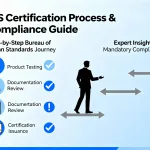
How the BIS Certification Process Works
To understand how manufacturers obtain certification, let’s break down the steps clearly:
Step 1: Choose the Right Standard (Indian Standard – IS)
Every product must comply with a specific “IS” number.
For example:
- IS 302 for household electrical appliances
- IS 616 for audio-video equipment
- IS 10322 for LED lighting
Step 2: Apply Online on the BIS Portal
Manufacturers — Indian or foreign — must submit:
- Factory details
- Product specifications
- Manufacturing process information
- Test reports
Step 3: Product Testing in BIS-Recognized Labs
This is one of the most important stages.
Your samples are tested for:
- Quality
- Performance
- Safety
- Durability
Step 4: BIS Inspection (For ISI Scheme)
A BIS officer may visit the factory to check:
- Production capability
- Quality assurance systems
- Raw materials and machinery
Step 5: Grant of BIS Certificate
Once all documents, tests, and inspections are approved, BIS issues the certification:
- ISI Certificate (for Indian Standards Institute scheme)
- CRS Certificate (for compulsory registration scheme)
Manufacturers can then print the ISI mark or CRS mark on their products.
Validity and Renewal of BIS Certification
A typical Bureau of Indian Standards Certificate is valid for:
- 2 years (for domestic manufacturers)
- 1 year for foreign manufacturers under FMCS
After the validity period, manufacturers must apply for renewal. The process is easier than the first-time application since most documents are already on record.
Benefits of Having a Bureau of Indian Standards Certificate
Let’s look at the practical advantages:
⭐ 1. Consumer Trust
Buyers instantly recognize the ISI mark. It reassures them that the product is safe and reliable.
⭐ 2. Legal Compliance
Manufacturing compulsory products without BIS certification can lead to:
- Heavy fines
- Product seizure
- Business closure in serious cases
⭐ 3. Improved Sales
Retailers, wholesalers, and even government tenders prefer BIS-certified brands.
⭐ 4. Reduction in Product Failures
BIS testing ensures that only high-quality products enter the market, reducing complaints and returns.
Common Challenges Manufacturers Face During BIS Certification
Even though BIS aims to simplify the process, manufacturers often experience:
- Complex documentation requirements
- Delays in sample testing
- Understanding the right IS standards
- Confusion between ISI and CRS schemes
- Technical queries from BIS officials
This is why many companies choose to work with BIS consultants who handle the paperwork, coordination, and end-to-end certification process.
How Consumers Can Verify BIS Certification
The Bureau of Indian Standards has made it very easy for consumers to check product authenticity through:
- BIS Care App
Simply enter:
- License number
- IS number
- Manufacturer’s details
The app will show whether the certificate is genuine.
- Online Verification on BIS Portal
Consumers can see:
- Validity date
- Product model details
- Status of license
These tools help prevent counterfeit ISI marks in the market.
Final Thoughts: Why BIS Certification Is the Future of Quality in India
As India grows into a major player in global manufacturing, quality and safety are becoming non-negotiable. The Bureau of Indian Standards Certificate is not just a regulatory requirement — it is a national effort to elevate India’s industrial excellence.
Whether you are:
- A manufacturer
- An importer
- A distributor
- A startup launching new products
Future Trends in BIS Certification and Indian Quality Standards
The role of the Bureau of Indian Standards Certificate is expanding rapidly as India pushes toward global manufacturing leadership. With new technologies, emerging product categories, and evolving consumer expectations, BIS is modernizing its systems to ensure more efficient and transparent certification.
Here are some important future trends:
- Digital-First Certification Processes
BIS is shifting from old paperwork-heavy workflows to faster, digital systems.
This includes:
- Online applications
- Digital document verification
- E-inspections using virtual tools
- Faster sample tracking through online dashboards
This modernization allows manufacturers to complete certification quicker, with fewer delays.
- Expansion of Product Categories
As technology progresses, many new products will enter compulsory certification.
Some upcoming categories include:
- Smart home IoT devices
- EV components and batteries
- Solar products
- Smart meters
- Wearable electronics
Businesses entering modern tech markets must be ready to comply with new Indian Standards.
- Stronger Surveillance and Market Monitoring
BIS is increasing post-certification market surveillance to catch:
- Fake ISI marks
- Non-compliant manufacturers
- Mislabelled imported products
This ensures only safe and authentic products remain in the Indian market.
- Support for MSMEs and Local Manufacturers
The government is promoting “Make in India,” so BIS is:
- Reducing certification fees for small manufacturers
- Simplifying procedures for low-volume production units
- Providing technical guidance through regional BIS offices
This makes the Bureau of Indian Standards Certificate more accessible to small businesses and startups.
Common Misconceptions About BIS Certification
Despite being widely recognized, there are several misunderstandings about BIS certification.
Let’s clear a few:
Misconception 1: BIS Certification Is Only for Big Companies
Fact: Even small manufacturers and home-grown brands must comply if their product falls under compulsory certification.
Misconception 2: ISI and BIS Are Different
Fact: ISI is an old name for Indian Standards.
BIS is the governing body.
So, an ISI mark actually represents that the product meets BIS standards.
Misconception 3: BIS Is Only for Indian Manufacturers
Fact: Foreign manufacturers who want to sell regulated products in India must also obtain the Bureau of Indian Standards Certificate.
Misconception 4: BIS Certification Is Only About Quality
Fact: BIS covers:
- Safety
- Performance
- Durability
- Environmental impact
- Consumer protection
It goes far beyond just “quality.”
Frequently Asked Questions (FAQs) About Bureau of Indian Standards Certificate
To help beginners and business owners better understand the process, here are some clear FAQs:
- What is the Bureau of Indian Standards Certificate?
It is an official mark of quality and safety issued by BIS for products sold in India. It ensures compliance with Indian Standards.
- Is BIS certification mandatory for all products?
No. It is mandatory only for products listed under the compulsory certification scheme, such as electronics, appliances, construction materials, etc.
- How long does it take to get a various BIS certificate?
Typically:
- ISI Certificate: 30–90 days
- CRS Certificate: 15–45 days
The timeline depends on product testing and document readiness.
- Can foreign manufacturers apply for BIS certification?
Yes. They must appoint an Authorized Indian Representative (AIR) before applying.
- What is the difference between ISI and CRS?
- ISI Scheme: For industrial, household, and safety-related products use the standard isi mark.
- CRS Scheme: For electronics and IT products requiring registration.
- What happens if a manufacturer sells products without mandatory BIS certification?
Penalties include:
- Heavy fines
- Product ban
- Legal action
- Possible factory shutdown in severe cases
- How can consumers verify a BIS (bureau of Indian standard certificate)?
Using the BIS Care App by entering:
- License number distributed in India
- IS number
- Product details
This ensures they purchase only genuine, certified products body in India.
Conclusion: The Power of the Bureau of Indian Standards Certificate
In a world where consumers demand safety, reliability, and authenticity, the Bureau of Indian Standards Certificate acts as a powerful trust symbol. It elevates brand reputation, ensures legal compliance, and supports India’s mission to promote high-quality products across every industry.
Whether you’re a manufacturer, importer, or a consumer wanting transparency, New BIS certification brings clarity and confidence to the marketplace. As the country moves toward global manufacturing leadership, receiving the BIS will continue to strengthen its systems, expand product categories, and uplift quality standards.