Introduction: Why Understanding TEC Certification Truly Matters Today
In the modern digital ecosystem—powered by 5G, IoT, machine-to-machine connectivity, broadband expansion, and cloud-driven telecom deployments—the term TEC Certification for telecom industry has become a critical compliance requirement.
As telecom products enter increasingly complex environments, India’s central regulatory authority—the Telecommunication Engineering Centre (TEC)—ensures that every device integrated into public networks is:
-
Technically compliant
-
Safe
-
Interference-free
-
Network-friendly
-
Secure
-
Compatible with national standards
Whether you’re an OEM, importer, system integrator, telecom operator, or a start-up launching new communication hardware, understanding tec certification, mtcte, and the mandatory testing and certification framework is essential to entering the Indian market legally and competitively.
This guide is designed for professionals who want authoritative, real-world, truly useful information—not AI-sounding fluff or generic explanations.
Let’s begin.
Understanding What TEC Really Does
Most people assume that TEC is a bureaucratic checkpoint. They hear terms like mandatory testing and certification of telecom equipment or MTCTE and immediately imagine stacks of paperwork. But if you stand inside a testing lab for a single day. you see the story differently.
Every product.. from a small optical transceiver to a massive network switch.. undergoes a complete conformity assessment and certification process that checks how it behaves under pressure. how it carries data. how it reacts to faults. how it protects users. and how it aligns with TEC standards.
It is not an abstract requirement. It is a very real guarantee that the telecom interface requirement in India can survive heat. interference. voltage spikes. cyber threats. and every unpredictable challenge that the real world throws at it.
Why TEC Certification Became Mandatory
When the Government of India finally declared the MTCTE certification and TEC certification is mandatory. many equipment providers were surprised. Some complained. Some hesitated. A few believed it would slow them down. But every certified product that entered the market after that decision carried a new kind of confidence.
The idea was simple.
Any telecom product that the people of this country depend on must undergo mandatory testing. The equipment must obtain a tec certificate prove itself inside a controlled lab so that it never fails outside one.
The list of products covered grew year by year. Wi Fi devices. transmission terminals. routers. smart meters. and dozens more. Every time a new category was added for issuance of the tec. the industry evolved.
The Role Of TEC In Shaping A More Reliable Telecom Environment
If you look closely at the journey of many companies. large or small. one pattern becomes clear. The TEC certificate did more than validate a device. It pushed manufacturers to redesign weak structures. to improve firmware. to document safety practices. and to understand their equipment more deeply.
I once met a start up founder who told me that the certification charges for start ups felt heavy at first. but the testing actually exposed flaws in their product which would have cost them much more after deployment. The TEC labs forced them to grow before they reached the market. He said the certification was not a barrier. It was a mirror.
The reimbursement of testing and certification charges later introduced for start ups and telecom MSEs made the journey even more achievable.
Inside The TEC Certification Scheme Process. A Walk Through The Real Steps
If someone asked me what the most misunderstood part of TEC certification is. I would say it is the process itself. People imagine it as a marathon of government forms. Yet the steps are logical once you know why they exist.

Manufacturers begin by studying the essential requirements for their product category. These essential requirements are not theoretical statements. They are very real performance expectations written after long consultations with industry experts.
Then comes product testing. Each device is tested for safety. electromagnetic compatibility. interoperability. security. and any other specific requirement. A technician once told me that no test is random. Every test tries to reveal how the product might fail in the field.
The test report becomes the backbone of the application for TEC certification. Once submitted on the MTCTE portal. the evaluation begins. If all goes well. the equipment receives a certificate number and enters the list of approved telecom products for use in India.
Some products receive general certification. Others fall under simplified certification. but all must complete the TEC registration process before entering the Indian telecom ecosystem.
How TEC Shaped The Market For Telecom Equipment In India
The market today looks very different from what it looked like ten years ago. The push for mandatory TEC certification has raised the quality threshold. Companies that once focused only on cost now focus on reliability. Start ups have become more disciplined about testing. Importers have learned to coordinate with an authorised representative in India.
And telecom operators.. who once struggled with faulty equipment.. now prefer products that carry a valid TEC certificate because it eases deployment risks.
Many experts believe that obtain certification encouraged manufacturers to bring higher quality products into India. The standards became a signal that the Indian market is not willing to compromise anymore.
Why The Certification Of Telecom Equipment Matters More Now Than Ever
Whenever I think about the country’s dependence on telecommunication. I think about the quiet hours of dawn when the whole city sleeps except for the network traffic that continues to pass through silent cables underground. Every call.. every message.. every transaction.. every emergency alert relies on equipment that has quietly proven itself through the testing requirements under the MTCTE approval is the process.
This is why TEC certification for telecom equipment is not merely a checkmark on a compliance list. It is the backbone for the confidence of an entire nation that relies on connectivity.
A Realistic Look At Challenges.. Not Everything Is Perfect
The process can feel heavy for newcomers. The documentation is extensive. The testing timelines sometimes stretch. And when the list of products covered expands. it forces companies to adjust quickly. Yet every mature industry has a certification system that demands effort. Aviation has it. Pharmaceuticals have it. Food safety has it. Telecom could not remain without it.
Looking Ahead.. TEC Will Continue To Evolve
India’s telecom sector is expanding into 5G. IoT networks. satellite communication. and smart infrastructure. With every advancement. the conformity assessment bodies and the telecom equipment must undergo mandatory are continuously updating standards. The future will bring more detailed testing. more clarity. and a stronger certification ecosystem.
The industry expects more support for start ups. modernised testing labs. and faster processing timelines. But even today. the foundation is stable. and the direction is clear.
A Simple Truth To Carry Forward
If there is only one thing I want you to take away from this entire discussion. it is this.
A telecom product is not certified for decoration. It is certified for the millions of people who will depend on it without ever seeing it.
A small label called the TEC Certificate of Conformity Assessment holds the weight of safety. trust. engineering discipline. and national reliability.
That is what TEC certification truly represents.
1. Understanding TEC: The Heart of Telecom Standardization in India
TEC (Telecommunication Engineering Centre) functions as the technical wing of India’s Department of Telecommunications (DoT). As the primary body responsible for establishing standards, evaluating compliance, and certifying devices, must obtain TEC ensures that telecom equipment application process used in India is:
-
Safe for consumers
-
Secure for networks
-
Technically reliable
-
Compatible with Indian telecom infrastructure
The telecommunication engineering centre creates Essential Requirements (ERs) that all manufacturers must meet.
2. What Is TEC Certification?
TEC Certification is an official approval issued by the Telecommunication Engineering Centre for telecom equipment to ensure that the device meets India-specific regulatory requirements.
It confirms compliance with:
-
Electromagnetic Compatibility (EMC)
-
Electrical safety
-
Technical specifications
-
Security protocols
-
Environmental parameters
The certificate is mandatory for all telecom products listed under MTCTE (Mandatory Testing and Certification of Telecom Equipment).
3. What Is MTCTE and Why It Matters?
MTCTE is the backbone of India’s telecom equipment regulation. Introduced under the Indian Telegraph Rules, MTCTE ensures that any telecom equipment in India must undergo:
-
Testing in TEC-designated labs
-
Evaluation by TEC engineers
-
Certification based on ER compliance
Once a product passes these stages, it becomes eligible for tec certificate registration.
Products covered under MTCTE include:
-
5G radios
-
LTE equipment
-
Wi-Fi CPEs
-
Routers and switches
-
IoT gateways
-
Smart metering equipment
-
GPON components
-
Security firewalls
-
IP cameras
-
Base stations
4. Certification of Telecommunication Equipment: A Complete Overview
Under the MTCTE framework, the certification of telecommunication equipment evaluates products for:
-
Radio frequency emissions
-
EMC interference
-
Electrical safety
-
Environmental durability
-
Cyber-security features
-
Network interoperability
This ensures that only qualified, safe, compliant devices operate within Indian telecom networks.
5. List of Products Covered Under MTCTE
TEC publishes an updated list of products covered under the MTCTE framework. The list includes:
-
Telecom switches
-
Wi-Fi routers
-
SFP modules
-
IP network cameras
-
Multiplexers
-
IoT communication devices
-
OTN products
-
Satellite communication terminals
-
Optical fibre systems
-
Telecom power equipment
You can refer to TEC’s official site or Wikipedia pages on telecommunications for cross-reference.
6. Telecommunication Engineering Centre: Role and Authority
The telecommunication engineering centre defines:
-
ER standards
-
Testing methodologies
-
Certification procedures
-
Telecom technology assessments
-
National interoperability protocols
It ensures alignment with:
-
ITU-T
-
IEEE
-
3GPP
-
IEC
-
ETSI standards
This is why TEC Certification is accepted as a high-value compliance mark.
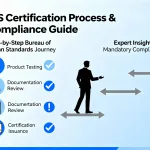
7. TEC Certification Process: Step-by-Step Guide

Below is a universally followed tec certification process:
Step 1 — Identify the Product Category
Match your product to an MTCTE category.
Step 2 — Prepare Documentation
Includes:
-
Technical datasheet
-
Internal block diagram
-
Circuit diagram
-
BoM
-
User manual
-
Label sample
Step 3 — Select Test Lab
Preferably a TEC-designated lab.
Step 4 — Testing Stage
Product undergoes:
-
EMC testing
-
Safety testing
-
Environmental testing
-
Technical parameter testing
Step 5 — Submit Test Reports
Test reports are uploaded to the MTCTE portal.
Step 6 — Evaluation by TEC
TEC evaluates compliance against ERs.
Step 7 — Certificate Issuance
Successful applicants receive the tec certificate.
8. Obtain of TEC Certification
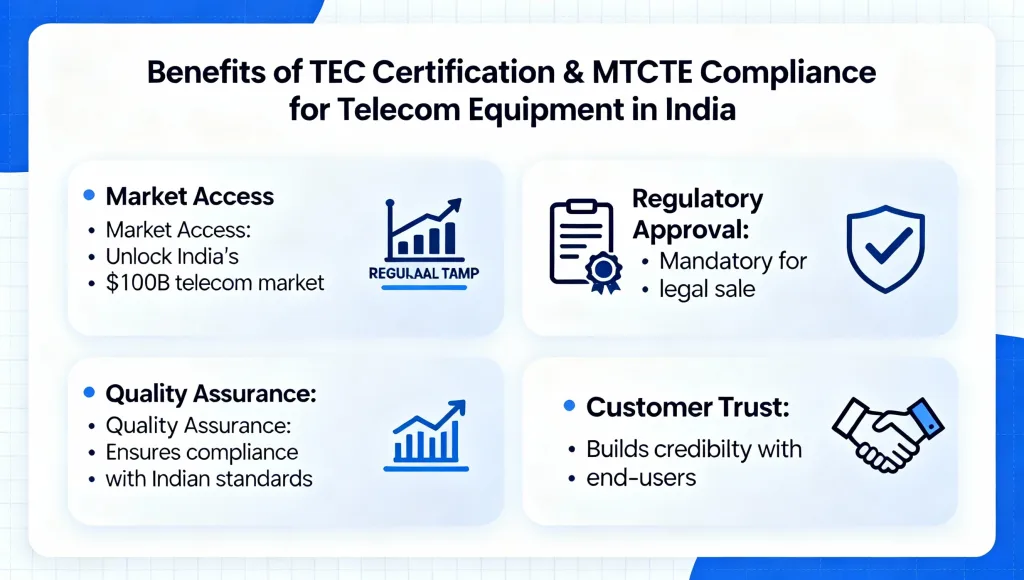
Here’s a simplified breakdown of obtain tec certification provided by TEC:
-
Helps regulate quality of telecom products
-
Protects national communication infrastructure
-
Ensures network compatibility
-
Enhances device reliability
-
Reduces network failures due to inferior hardware
- Reduces testing and certification of telecommunication
TEC Certification is both a quality stamp and a mandatory regulatory requirement.
9. TEC Certificate Registration Explained
Once testing is complete, manufacturers proceed to tec certificate registration process, which includes:
-
Uploading all documents
-
Completing OEM authorization
-
Attaching test reports
-
Paying the registration fee
-
Submitting the online Tec Certification number of application
The certificate number is then assigned.
10. Conformity Assessment: Understanding Its Role
The conformity assessment ensures the product meets TEC Certification prior:
-
ERs
-
Labeling rules
-
Safety requirements
-
EMC standards
-
Security protocols
A product that fails conformity assessment must be re-tested.
11. Testing and Certification for Telecommunication Equipment
Testing and certification of telecom equipment involves rigorous lab procedures including:
-
Conducted emission tests
-
Surge tests
-
Radiated disturbance tests
-
Environmental cycling tests
-
Safety insulation checks
-
Performance validation
This is a mandatory stage before TEC Certificate number of application for grants approval.
12. Testing Requirements Under the MTCTE OR TEC Mandatory Certification
The testing requirements under the MTCTE Certificate vary according to the product category.
Common requirements include:
-
EMI/EMC tests
-
Electrical safety tests
-
Environmental (climatic) tests
-
Technical function tests
-
Security testing (for specified categories)
13. TEC Approval: What It Means for Manufacturers
Once TEC is satisfied with test compliance for certification of telecom products, it issues tec approval, allowing:
-
Import of products
-
Sales within India
-
Integration into networks
-
Government procurement eligibility
Manufacturers can then print TEC-approved labels for telecommunication equipment in India.
14. Apply for TEC Certification: A Useful Checklist
To apply for tec certification or Tec registration in India, applicants need:
-
OEM authorization
-
Local representative details
-
Test report copies for applicable certification
-
Self-declaration forms for tec online
-
Brand proofs of product certification
-
Payment receipts
15. Registration Online: How to Submit Applications
TEC’s registration online system enables:
-
Document upload
-
Fee payments
-
Sample validation
-
Status tracking
-
Certificate issuance
User-friendly and transparent.
16. Department of Telecommunications: Governing Authority
The Department of Telecommunications undergo mandatory testing and certification oversees:
-
TEC operations
-
National telecom policy
-
MTCTE implementation
-
Lab accreditation
-
Regulatory enforcement
17. Equipment in India: Why Testing Is Essential
All telecom equipment in india must meet ER standards to reduce:
-
Network congestion
-
Interference issues
-
Device malfunction
-
Safety hazards
18. Essential Requirements (ERs): The Core of TEC Compliance
ER documents specify mandatory parameters. They include:
-
Functional requirements
-
Technical requirements
-
EMC requirements
-
Safety and environmental requirements
19. Certificate Number and Labeling Rules
TEC assigns a certificate number that must appear on:
-
Product label
-
Packaging
-
Technical manual
-
Compliance declarations
Incorrect labeling leads to rejection.
20. List of Products Covered and How Often They Update
The list of products covered under MTCTE expands annually, often adding:
-
New IoT categories
-
RF products
-
Smart devices
-
Security equipment
Voluntary Certification Explained
Products not in the MTCTE list may obtain voluntary certification, which enhances credibility.
Reimbursement of Testing and Certification for Start-Ups
Government schemes allow reimbursement of testing and certification for eligible start-ups and telecom mses.
Certification Charges for Start-Ups: Latest Information
Certification charges for start-ups are often subsidized, encouraging indigenous innovation.
Telecom Product Documentation Requirements
A telecom product requires:
-
Product description
-
Circuit diagram
-
Test report
-
Manufacturing details
TEC Certification in India: Why It Is Mandatory
tec certification in India is mandatory because:
-
Ensures network reliability
-
Reduces interference
-
Protects national telecom infrastructure
Conclusion: TEC Certification for Telecom Industry
The TEC Certification for telecom industry has become the cornerstone of regulatory compliance in India. With rapidly growing digital infrastructure and increasing telecom dependencies, ensuring the safety, quality, and process of testing reliability of telecom equipment is more critical than ever.
By understanding:
-
TEC
-
MTCTE
-
Essential Requirements
-
Testing procedures
-
Documentation
-
Online registration
-
Certificate issuance
manufacturers and importers can confidently navigate India’s compliance landscape and bring high-quality telecom products equipment must undergo mandatory testing to the market.
There is a moment in every technology sector when rules stop feeling like restrictions and start feeling like the backbone that holds an entire industry together. When I first learned about the Telecommunication Engineering Centre many years ago. it was during a conversation with a senior engineer who had spent three decades working on telecom equipment in India. He told me something I never forgot. He said that telecom equipment is not just hardware. It is trust. It is reliability. It is the invisible architecture of a country that never sleeps.
That was my first introduction to the weight carried by TEC Certification technology approval. I understood that this was not simply a regulatory formality. It was a learning curve for manufacturers. importers. start ups. and the entire network of people responsible for the testing and certification of telecom equipment that keeps India connected.
FAQs
1. What is TEC Certification?
TEC Certification verifies compliance with India’s telecom standards.
2. Is MTCTE mandatory?
Yes, for all listed telecom equipment.
3. How long does TEC certification take?
Generally 30–75 days depending on the product summary of the test.
4. Who needs TEC certification?
Manufacturers, importers, telecom OEMs, and integrators.
5. Is testing compulsory?
Yes. Products must undergo TEC-approved testing of telecom equipment.
6. Can start-ups apply?
Absolutely. Start-ups can obtain subsidies and reimbursements.